|

The BFHR warns that the continued detention of dozens of religious scholars since May, along with their prolonged confinement under the authority of security agencies and prison administrations, leaves them vulnerable to further abuses—particularly amid repeated reports of torture, physical and psychological assault, and threats.
The Forum considers the scholars’ continued detention to be part of an ongoing policy by Bahraini authorities to target and punish Shia religious figures. Their ongoing trial lacks even the most basic guarantees of due process and reflects the use of judicial proceedings as a tool for exerting psychological and emotional pressure on detainees and their families.
At the latest hearing, the families of the detained scholars and human rights activists were barred from entering the courtroom. This action violated the principle of public trials, particularly in a case that has attracted widespread attention across Bahraini society.
The BFHR highlights a series of legal irregularities and violations that have marred the investigation and trial proceedings that cannot be overlooked. It stresses that the case files raise serious questions about the validity of the charges and the credibility of the investigation.
A review of the interrogation records revealed that questioning of different defendants was recorded as beginning at the exact same minute before the same prosecutor, with a similar discrepancy appearing on another occasion. There were also striking similarities between statements attributed to different defendants, despite several scholars denying having made those statements.
The case files also contain significant contradictions regarding the date on which the alleged organization was established. The Forum further raises concerns over the failure to provide original files relating to complaints of coercion and ill-treatment, as well as the surveillance footage requested to verify the circumstances of the interrogations.
The continued detention of the scholars is particularly alarming given the abuses they have suffered in interrogation centers and prisons, several of which the BFHR has documented in previous statements.
Among the most notable cases is that of prominent religious scholar Sheikh Mohammed Sanqour, who revealed during a court hearing on October 7, 2026, that he had been subjected to torture and coercion, as well as severe violations of interrogation procedures. He called for the release of interrogation recordings to verify his account and establish the accuracy of the statements recorded in the official transcripts.
The Forum also documented an assault on Sheikh Ali Al-Mustarshid at Dry Dock Prison on October 1, 2026, followed by his transfer to solitary confinement. It has also received accounts of physical assaults and ill-treatment involving other religious scholars held across detention facilities.
The BFHR warns that keeping the scholars in security custody amid ongoing abuses perpetuates impunity and exposes them to cruel, inhuman, or degrading treatment. This is particularly concerning given reports that some scholars have faced beatings, threats of sexual assault, and threats of violence against their family members. Such actions constitute severe forms of intimidation and psychological abuse.
In light of these facts, the Bahrain Forum for Human Rights reiterates its firm condemnation of the trial of Shia religious scholars, stressing that it is legally invalid and politically motivated. The proceedings are based on investigation procedures marred by severe violations and confessions obtained through coercion and torture.
Postponing the verdict does not establish the court’s integrity, justify keeping the scholars behind bars, or erase the abuses they have endured. The BFHR therefore reiterates its demand for an immediate end to their prosecution and their unconditional release. Judicial proceedings must no longer be used as a pretext for prolonging their detention and exposing them to further harm.
The Forum holds the Bahraini authorities fully responsible, both politically and legally, for the scholars’ continued detention, their physical and psychological safety, and any retaliatory measures they may face—particularly those who disclosed torture and coercion before the court.
The BFHR stresses that beatings, excessive use of force, and the infliction of physical and psychological harm on detainees constitute clear violations of Article 19(d) of the Bahraini Constitution, which prohibits physical and psychological torture and degrading treatment, and Article 20(d), which prohibits causing physical or psychological harm to an accused person.
Article 208 of the Bahraini Penal Code, as amended by Law No. 52 of 2012, also criminalizes the intentional infliction of severe pain or suffering on a detainee by a public official for the purpose of punishment, intimidation, or coercion, establishing criminal liability for such acts.
At the international level, these practices violate Bahrain’s obligations under Articles 7 and 10 of the International Covenant on Civil and Political Rights (ICCPR), which prohibit torture and cruel, inhuman, or degrading treatment and require states to treat all persons deprived of their liberty humanely and with respect for their dignity.
Articles 2, 12, 13, and 16 of the Convention against Torture (CAT) further require states to take all necessary measures to prevent torture and ill-treatment, conduct prompt and impartial investigations into such abuses, and ensure that victims can file complaints without fear of retaliation.
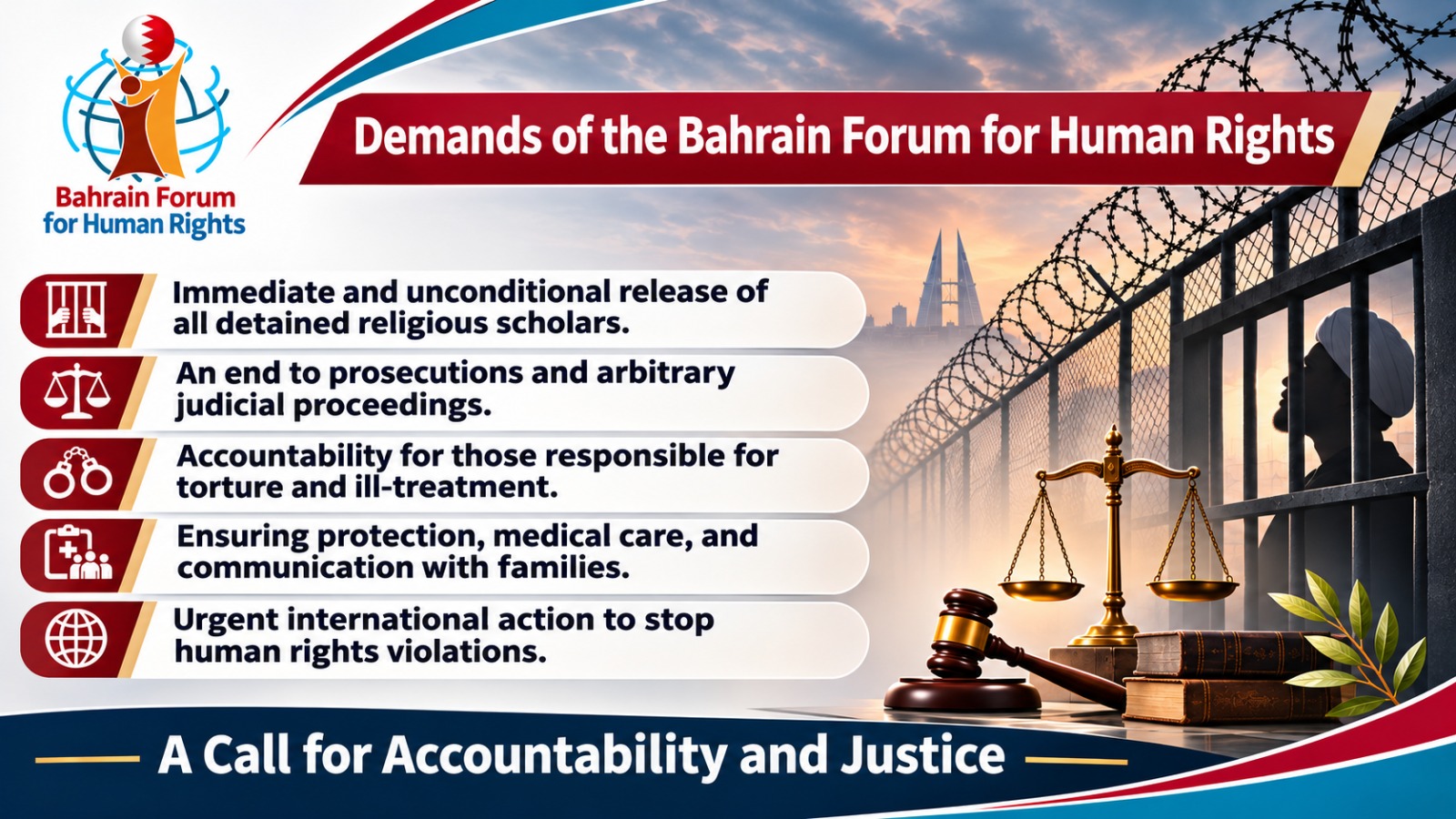
In light of the above, the Bahrain Forum for Human Rights calls for:
1. The immediate and unconditional release of all detained religious scholars and an immediate end to all judicial proceedings against them.
2. An end to the arbitrary detention of the scholars and the cessation of using judicial proceedings as a tool for punishment and psychological pressure.
3. An end to arbitrary judicial proceedings and guarantees of fully public trials—including allowing detainees’ families and human rights observers to attend hearings in accordance with the law, granting defense lawyers full access to case files and interrogation records, and verifying the credibility of prosecution witness testimony.
4. Accountability for those responsible for assaults, torture, coercion, and ill-treatment—including the abuses disclosed by Sheikh Mohammed Sanqour before the court, the assault on Sheikh Ali Al-Mustarshid, and all other cases of ill-treatment of religious scholars in detention facilities—and releasing all interrogation recordings and related documents.
5. The disclosure of interrogation recordings, witness statements, and disputed evidence; a formal investigation into allegations of coercion and falsification of official records; and the strict exclusion of all evidence and confessions obtained through torture, threats, or unlawful pressure.
6. Immediate protection for all detained scholars and prisoners, including access to necessary and independent medical care, unhindered communication with their families and lawyers, and safeguards against retaliatory measures for their court testimony or for asserting their rights, including their participation in peaceful hunger strikes.
7. Urgent action by the international community—particularly the UN Human Rights Council and the Office of the High Commissioner for Human Rights (OHCHR)—to hold the Bahraini authorities accountable for arbitrary detention, torture, and prosecutions linked to peaceful religious practices, and to activate available international oversight and accountability mechanisms.
8. Urgent intervention by the UN Special Rapporteur on Torture, the Working Group on Arbitrary Detention, and international and regional human rights organizations to monitor the scholars' cases and prison conditions, work to halt violations, prevent any further deterioration of the human rights situation in Bahrain, hold those responsible accountable, and ensure redress for victims.
|